


Projective techniques offer unique ways to bridge the gap between your conscious mind and the often-hidden depths of your unconscious.
By working with these techniques, you can uncover deep feelings you might struggle to connect with directly or unconsciously project onto others.
The best political, social, and spiritual work we can do is to withdraw the projection of our shadow onto others.
Carl Jung
When Do Projective Techniques Help?
These techniques are beneficial when you feel stuck in a problem and rely heavily on logic alone. Our creative and intuitive side sometimes has the answers we need, but it speaks a different language.
Projective techniques allow us to access that wisdom.
Classic and Modern Projective Techniques
Many techniques fall into this category: tarot cards, I Ching, astrology… they each tap into the symbolic meaning of archetypes and ancient wisdom. Modern variations are Rorschach tests or innovative card games like Points of You.
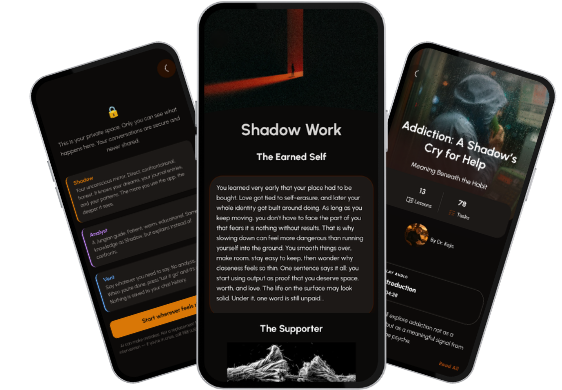
Mindberg’s app also features specialized projective techniques tailored to everyday experiences for easy connection.
The Power of Projection
Projection occurs when we unconsciously transfer our own thoughts, feelings, or personal traits onto another person or situation, often misinterpreting them as belonging to the outside world.
Through projective techniques, we gain the ability to identify these projections, shedding light on aspects of ourselves we might not be consciously aware of. This process is crucial for enhancing self-awareness and resolving internal conflicts.
By recognizing and understanding our projections, we can achieve a clearer self-perception and develop a more accurate understanding of others. This clarity fosters healthier relationships and personal growth, enhancing our self-understanding and interactions with others.
Harnessing the Power for Growth
Projective techniques uncover aspects of ourselves we sometimes prefer to conceal – emotions, beliefs, and even talents – but instead project onto the external world.
Through techniques like those found within the Mindberg App, you face these with increased conscious awareness. Not only does this offer improved self-control, but it also creates better relationships and more profound life satisfaction.
With Mindberg app, projective techniques aren’t just about gaining temporary insights – they are catalysts leading you toward a genuine understanding of who you are, giving you more strength and flexibility to navigate life.
Discover the Real You
Astrology as a projective technique
Since astrology is a widely spread and commonly used modern projective technique, let’s explore how it works from a psychological point of view.
Keep in mind that we are not an astrology site and that we do not discuss the astrological meanings of planets. Instead, we focus on the symbolic and projective meanings of astrology from a psychological perspective.
Jung said that the first projection of the human soul was into the starry sky. Humanity is about 200,000 years old, and for just a little over 100 years, we have had electricity and organized lighting at night.
Can you imagine that our great-grandparents lived by candlelight at night? Without TVs, computers, cell phones, and the internet? What did they do then? Imagine how brilliantly clear the starry nights were when there was no city lighting and no air pollution from industry.
It was this starry sky that was the source of entertainment for our ancestors. In the seemingly senseless combination of millions of stars, they sought patterns and assigned certain names and meanings to those patterns, projecting their unconscious psyche and the world around them into the sky.
Therefore, the connection between zodiac signs, planets and our own lives is not cause-and-effect, i.e., literal and direct. The connection is rather symbolic and metaphorical. For thousands of years, people “assigned” personal traits to the planets they were observing in the sky.
So, at a projective level, synchronistically and meaningfully, horoscopes make sense, while in cause-and-effect terms, they do not.
Carl Jung saw the zodiac not as a system for literal prediction, but as a symbolic map of the human psyche. He believed the archetypes embodied by astrological signs reside within the collective unconscious of humanity.
For Jung, astrology wasn’t about foretelling events but about offering insight into deep-seated psychological patterns and potentials. He viewed the zodiac as a tool for self-understanding and exploring the complexities of the unconscious mind.
Related blogs

Carl Jung and Astrology: Symbol, Synchronicity, and the Psyche
Explore Carl Jung's view of astrology as an inherited symbolic system, its relationship to archetypes and synchronicity, and the limits of its claims.